

Forty years after a notorious terror plot hit the headlines, journalist Harry Turnbull recalls lunch with the man who was planning mass murder.
Nezar Hindawi did not look like a man who would soon be regarded as one of Britain’s most despised figures. He greeted me at the door of his family’s Earl’s Court apartment with a broad smile and an easy charm.
There was nothing to suggest he was about to try and blow up an Israeli passenger jet using his pregnant bride-to-be as an unsuspecting bomb courier.
That dinner engagement has haunted me for four decades, and as the 40th anniversary of Hindawi’s incarceration loomed I reached out to find out what had happened to the man who tried to commit an act so grotesque it merited what was then Britain’s longest sentence.
But it is extraordinary the lengths the British state will go to protect the guilty. I discovered this while trying to track down what happened to him when a Freedom of Information request to the National Archive resulted in being informed the files were locked till at least 2069 in case there were reprisals against those involved. When I asked them to elaborate on that it was met with silence.
But what the government did tell me is that Hindawi’s 45 year sentence imposed at the end of October 1986 and due to end in 2031 was quietly shortened in 2013 when he was allowed to leave the notorious terrorist prison Whitemoor. The Home Office has finally conceded he was released despite successive ministers blocking an early departure. And what is more, he left without any of the usual license conditions; no monitoring, no reports, no recall.
As a foreign national with a deportation order to Jordan, he would have been removed from the UK immediately but no statement was issued. No record of his deportation appears in the public domain.
Recalling our meeting
I still recall that dinner table vividly. The past came alive. Nezar and his father wove a verbal tapestry of Palestine, painting a picture of olive groves stretching endlessly under a golden sun, lush pastures rolling down to a sparkling coastline, and the intoxicating aromas of citrus and herbs carried on warm Mediterranean breezes. Their words were vivid, almost tactile, and for a moment I could almost feel the sun on my skin and taste the salt in the air. But then the conversation took a darker turn when his father explained they had lost the family farm when Israel took over under a United Nations decree in 1948.
Nezar had been born in a Jordan refugee camp but later the family’s fortunes improved and they ended up in London. Through a friend he met Irish chambermaid Ann-Marie Murphy
While we chatted and he passed a bowl of olives, he harboured his murderous secret, one he would attempt to enact just a few days later.
Around the dinner table the conversation drifted from the history of Palestine — of which I was, frankly, rather ignorant — to personal beliefs. At one point Nezar asked me: “Harry, do you have a belief, do you have faith?” I replied, perhaps too lightly: “I believe in the Holy Trinity.”
“Ah, a Christian,” he said.
“I was actually referring to Best, Law and Charlton.”
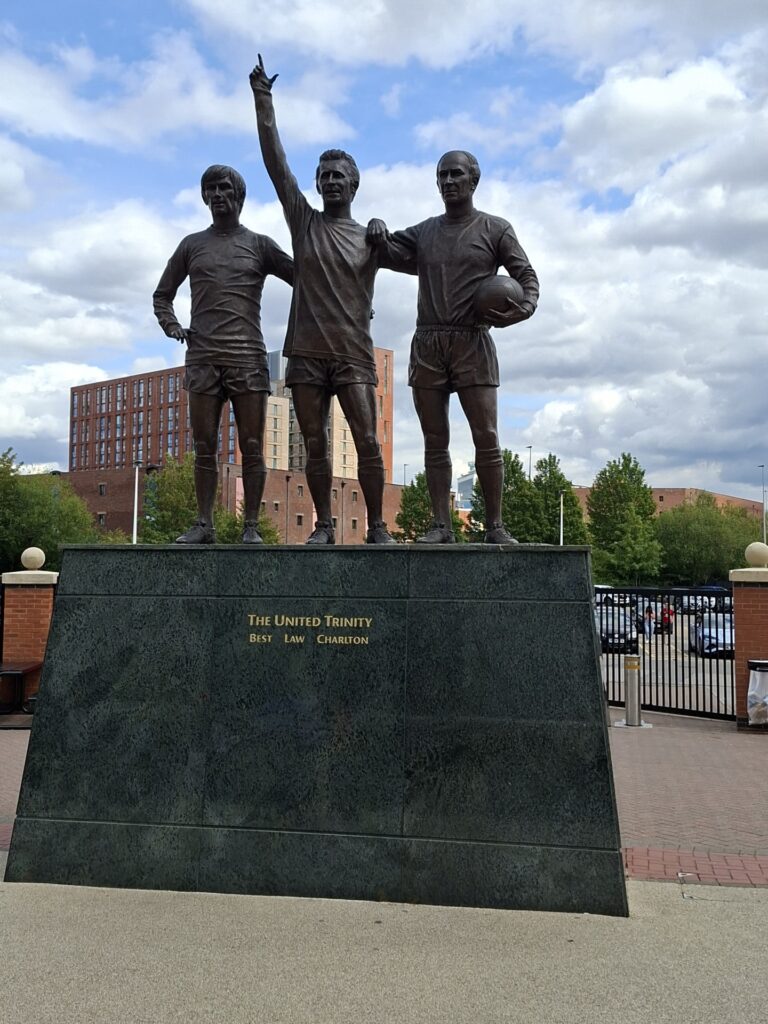
He and his father looked perplexed until I explained: Manchester United’s legendary trio, nicknamed the Trinity. The joke aside, I did go on to describe my upbringing as a Methodist and a member of the Boys’ Brigade. This seemed to animate Nezar. He spoke as if the Boys’ Brigade were some kind of paramilitary youth movement — a misunderstanding that only made sense later, when the full details of his past emerged.
He did not present as a zealot. Far from it. He spoke of discos and casinos, of nights out in London, and then — with equal ease — of parables from the Holy Land. In retrospect, the mixture feels enigmatic: a man whose thinking was muddled, whose belief system was scarred by experience, and whose grievances ran far deeper than he let on.
A little over a week after that dinner at the Hindawis, I had finished work at the newspaper in Wigan where I was a reporter, and had headed to the pub. The regulars, old-timers silently quaffing their pints of Mild, were glued to a dominoes table. On a television screen the 6 p.m. news had just begun when I caught a few words about a terror plot. I turned away from my conversation to glance at the screen—and froze. There, staring back at me, was a slightly faded headshot of a man I instantly recognized: Nezar Hindawi.
It was this element — the exploitation of a pregnant woman who trusted him — that made Hindawi uniquely monstrous. The plot was not just an act of terrorism. It was an act of intimate betrayal so grotesque that even in an era of hijackings, bombings and geopolitical violence, it stood apart.
Ann‑Marie Murphy became chief prosecution witness, having given birth to a girl called Sarah.
At the trial the prosecution’s case was devastating;. a plan to destroy an El Al Boeing 747 carrying 358 passengers and 17 crew, using an innocent young woman — six months pregnant with Hindawi’s child — as the unwitting courier of a bomb made of plastic explosives. Murphy believed she was flying to Tel Aviv to marry.
Luckily Israeli security services thwarted the plot at Heathrow and Hindawi soon gave himself up, fearing his Syrian paymasters would assassinate him.
One man who also remembers the momentous trial — which led Margaret Thatcher to break off diplomatic relations with Syria — is the chief prosecutor, Roy Amlot KC.
When I contacted him, he replied with a measured but unmistakable conviction: Hindawi, he said, was “the worst” of the many killers and would‑be killers he had brought before the courts.
“It was a long time ago, but I remember him as a cold calculating figure, without any emotion. There was a dramatic moment in the trial when his counsel, Gilly Gray QC, put to Ann Murphy that she was still in love with Hindawi and she agreed. He then added that she knew that Hindawi was also still in love with her and she seemed to agree. That was the last question but as she left the witness box, she screamed an obscenity at the defendant. He did not react.
“I prosecuted many evil killers or would be killers but he I think, was the worst. It was bad enough to plot the destruction of a civilian aircraft containing 358 passengers and 17 aircrew, but using an innocent young woman, whom he had persuaded to take the flight with the bomb on the pretence that they would marry in Tel Aviv and who was pregnant by him was beyond the pale. It was mere chance that the Israeli security officer at the airport felt that her bag should have been lighter than it was after he emptied it that the Semtex was found. The bag had already been x-rayed and nothing found.”
Lord Justice Mars Jones handed down a 45 year sentence.
Although he was eligible for parole in 2001 ministers kept blocking his release and then something changed – the law. New legislation in 2010 took the power of prevention away from ministers and put it in the hands of the Parole Board who gave him the nod in 2013, three years before the two thirds of sentence parole date required by law and fully 18 before the end of the term.
The episode raises the question that has haunted me since that Sunday lunch in Earl’s Court: what motivates a man not only to plan mass murder, but to use the people closest to him as the mechanism?
Perhaps it was ideology. Perhaps it was desperation. Perhaps it was the muddled thinking of a man whose life had been fractured by exile and violence. Or perhaps — and this is the hardest possibility to confront — he simply did not care. The contrast between the man I met, charming and attentive, and the man who placed a bomb in his fiancée’s luggage, remains impossible to reconcile.
His daughter, born into the aftermath of a plot that almost killed her, has lived her life far from the headlines that once defined her mother’s.
And Hindawi — once one of the most reviled men in Britain — has vanished into a silence the state appears determined to maintain.