
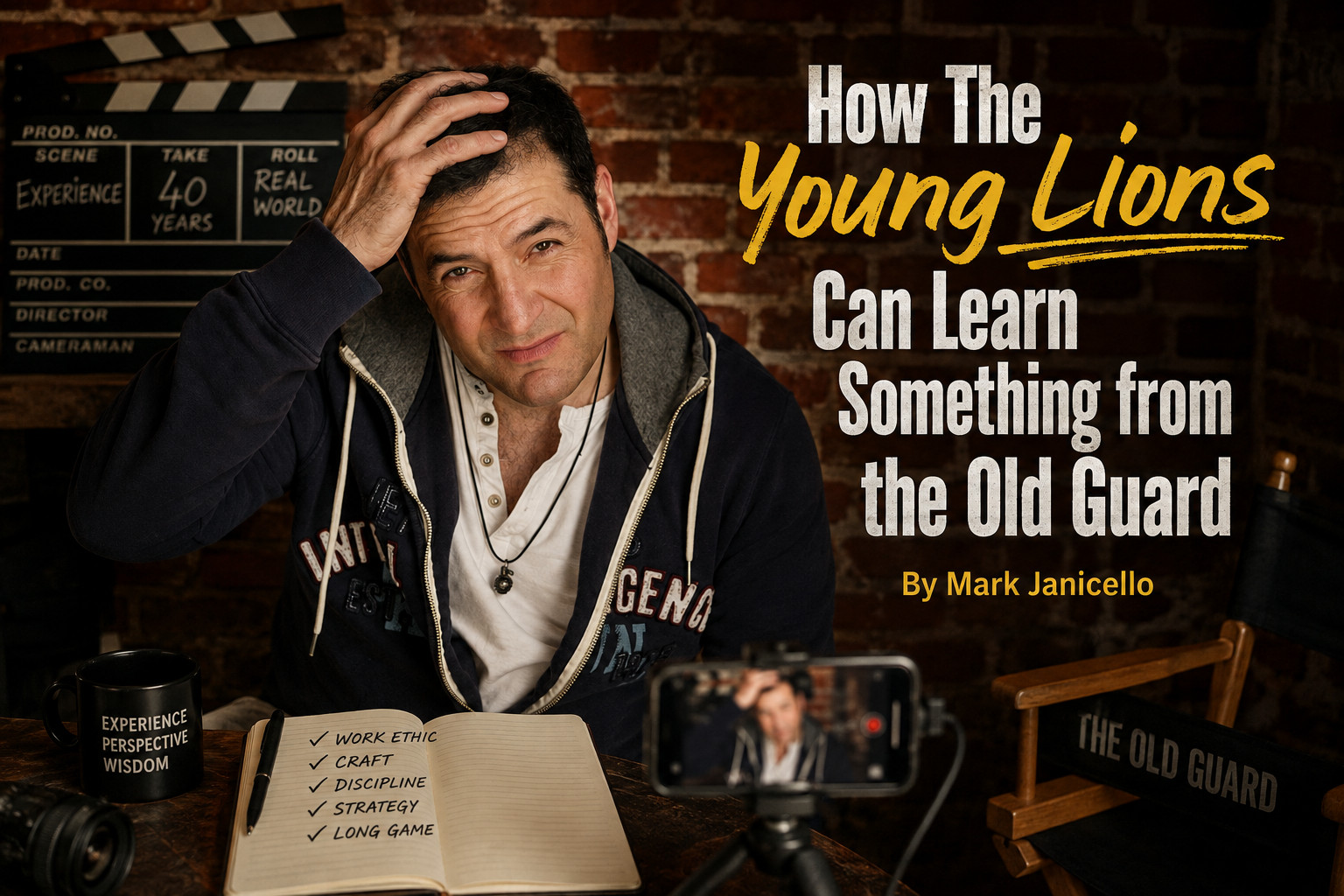
By Mark Janicello
When we’re young, we all suffer from the same beautiful, terrifying delusion: we think we have the world completely figured out.
Personally, I was the non plus ultra of delusional. At twenty-one, fresh out of university, I genuinely believed I would waltz into New York City, open my mouth to sing at an audition, and immediately land the lead in a Broadway musical. That musical would naturally be filmed, and I would seamlessly transition from the stage to the silver screen a la Barbra Streisand or Hugh Jackman. I was dead certain that my raw talent would be instantly recognized by the industry. I was absolutely certain that my money, my career, and my entire life would unfold on a golden pathway, just like in the movies.
SURPRISE!!!
It turns out the entertainment industry—and this includes any and all creative disciplines—is a massive breeding ground for this exact brand of instant expertise, and delusion.
Take a recent project I worked on. The director is a twenty-two-year-old, up-and-coming filmmaker. He is the ultimate poster child for the modern “creator.” He shoots everything on a mobile phone, edits in his bedroom, and distributes his films entirely via social media. Frankly, his digital metrics are staggering. With just a handful of video projects, this young man has amassed millions of views and tens of thousands of subscribers.
When I was first offered the part, I was genuinely surprised. After I received his script, I stared at the pages in absolute bewilderment. It was, on paper, without a doubt, one of the weirdest pieces of writing I have ever encountered. But hey, I’m a veteran actor. I admire moxie, and I always try to support the next generation of artists. So, I signed on, braced myself, and did the work.
Recently, I attended a private screening of the finished film, absolutely terrified of what I was about to see on the screen. But when I saw the film, my jaw hit the floor in disbelief. It was quite brilliant. It was funny, entertaining, and genuinely unique. The kid actually had serious, undeniable talent. His manner of storytelling is one-of-a-kind. On top of that, he is extremely hard-working and ambitious beyond belief. Having a uniquely individual point of view as a filmmaker is worth gold in Hollywood.
Unfortunately, this is exactly where the fairy tale ends and the blinding frustration begins.
Life Imitating Art (And Flirting with Irony)
In a twist of supreme irony, the movie itself actually mirrors our exact real-world dynamic—except the roles were completely inverted.
In the film, this young man stars as the main character: a young, scrappy filmmaker. Because he is a modern multi-hyphenate, he also directed, wrote, and edited the entire film. I play his character’s idol: a hugely successful, venerated Hollywood director.
In our big scene together, my character agrees to meet this ambitious young filmmaker in a coffee shop. But the moment the seasoned director hears about his “cutting-edge” methods—shooting “masterpieces” on a consumer cellphone—he is at first dumbfounded, and then completely loses it. He reads the kid the riot act for trivializing the “sacred art of filmmaking.” Dripping with disdain, my character barks at him, warning that if he ever shows up on a real Hollywood film set without proper, professional equipment, he will be laughed right out of the studio.
It was an incredible scene to shoot. My fictional character was rigid, dismissive, and utterly unyielding.
In real life, I took the exact opposite approach. Off-camera, I applauded the young filmmaker’s incredible work ethic, talent, ambition, and moxie. I praised his undeniable skill and unique storytelling viewpoint. But as a veteran who wants to see raw talent actually survive this industry, I gently encouraged him after the screening to expand his vision a bit. I suggested he integrate time-tested promotional strategies and perhaps start to include a few traditional filmmaking techniques to elevate his work even further.
And how did our brilliant young auteur respond to my real-world support?
He laughed at me.
The Master of the Universe (at Age 22)
The fundamental problem with twenty-two-year-old artists—or twenty-two-year-old anythings—is that they “have it all figured out.”
In this young man’s case, he mistakes a high view count for a lifetime achievement award. When you’re young, you possess an absolute, impenetrable certainty about how everything works. This young man knew exactly how the entertainment industry operated—or rather, how he thought it should operate. In their rush to be digital pioneers, young artists are gleefully slamming the door on massive, career-altering opportunities because they cannot see past their own smartphone screens.
After watching his excellent final cut, I offered some standard, common-sense veteran advice.
“This film is so good, I think you should enter it in some high-profile film festivals,” I suggested. “I think you could win some awards with this movie. Perhaps think about postponing the social media premiere until after the festival circuit wraps up to maximize your industry exposure.”
It was a logical, time-tested strategy designed to get his work in front of people who actually write big cheques. It was a path to help him transition into feature-length films, instead of just creating short, internet-ready entertainments.
His response, filtered through an unmistakably arrogant real-life chuckle, was a casual shrug: “I don’t give a damn about Hollywood and the industry.”
I had to bite my tongue so hard I nearly drew blood. The kid had literally written a script about a veteran putting an amateur in his place for being unprepared. Yet here he was, talking to someone who has worked for 40 years in the industry he was just entering, laughing at my suggestions and dismissing the very infrastructure he will need to survive the vagaries of a life in the arts.
The App Store Won’t Pay Your Mortgage
It is a lovely, romantic, Hollywood-ready artistic battle cry. It sounds fantastic on paper. But independent defiance without a long-term strategy can lead to professional suicide. Art needs a village. Artists need support—mentally, physically, and emotionally—to survive the ups and downs that come to every career.
I looked at this digital prodigy and laid it out straight: “Perhaps at twenty-two, you don’t care about Hollywood. But in ten years, when you’re thirty-two, with a mortgage, real responsibilities, and a family to support, your perspective might change drastically. Right now, you’re young, fresh, and new. You’re the ‘next big thing.’ The industry is sniffing all around social media at the moment to find young filmmakers like you. But in ten years, the next generation of fresh, young things will already be nipping at your heels.”
Control is an aphrodisiac. Running a perpetual one-man show delivers a specific type of adrenaline rush. You are the director, the camera operator, the editor, and the marketing department. The buck stops with you. You make all the decisions. Artistically, you’re God!
But the digital hustle is a meat grinder. Eventually, everyone gets exhausted.
The traditional industry—with its distribution networks, legal frameworks, and financial infrastructure—does not exist solely to crush your soul and destroy your vision. Used the right way, it can help turn your frantic hobby into a sustainable, lifelong career.
Life imitates art, but not always the way you think it will. Sometimes the Old Guard has something to learn from the Young Lions, and sometimes, the Young Lions need to learn how to hunt for the big prey, not just the next million clicks.
Clicks fade. Connections and a robust network don’t. Dismissing the entire entertainment ecosystem does not make you a brave artistic rebel. It just makes you a stubborn, inexperienced artist sitting alone in a room, waiting for an algorithm to love you back.
Author Bio: Mark Janicello
Mark Janicello is an American actor, singer, author, and producer with over thirty-five years of experience across the international stage and screen. Known for his versatile career bridging classical performing arts and modern entertainment, Mark regularly contributes sharp, candid insights on the intersection of artistic talent and the realities of commercial media business. He is a frequent contributor to Creative Business News, writing columns that challenge modern arts education and industry trends.